

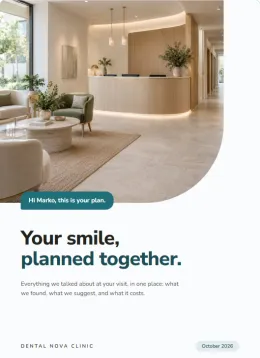
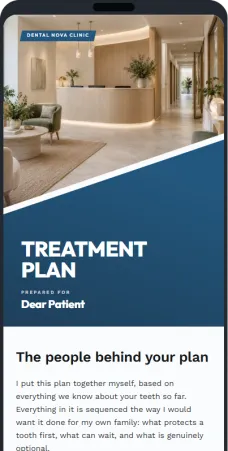
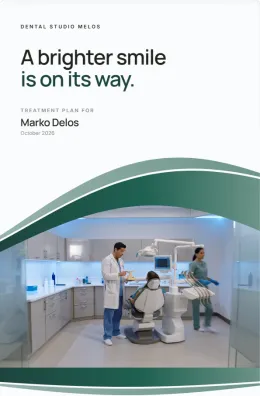
Patients say yes in their own language.
Patients who fly in, or moved here, decide on their treatment from the document you send. Plan in your language and send the plan in theirs - composed in any of 13 languages, so it reads like a dentist there wrote it. Your clinic is open to every patient who finds you from abroad.
- 13 document languages
- Any currency at the ECB reference rate
- You approve it before it goes
A patient says yes to what they understand.
They understand the procedure in the chair, with you explaining it. Then the plan goes home with them, and the decision is made there - in the language they think in, with a partner who may not speak yours at all. A proposal in the patient's own language is comprehension, and it is respect. Both decide the yes.
-
Dental tourism
Clinics in Croatia, Hungary and Turkey treat patients from Germany, Austria, Italy and the UK. The plan is read at home, before the flight is booked. If it isn't in the patient's language, the next clinic's plan might be.
-
Expats and cross-border patients
A Polish family in Dublin. A German retiree on the Costa Blanca. A Croatian commuter in Graz. They follow you in the chair; they decide at the kitchen table, in their own language.
-
The partner who reads it
The plan goes home to a spouse, a parent, the sibling who is paying. They read it in their language, or they don't read it. The plan that explains itself to the whole family is the plan that gets accepted.
Plan in your language. Send in theirs.
Nothing about the way you plan changes. The language is a choice you make per plan, at the moment you send it.
-
Plan as you always do
On the tooth chart, in your own language, with your own pricebook and your own educational topics.
-
Choose the patient's language when you send
In the Delivery menu, per plan. One patient gets the plan in German, the next in Hungarian, from the same clinic and the same workflow.
-
The plan composes itself in that language
Headings, price tables, timeline and financing, procedure names, healing narratives and the closing page - with the plural forms right and the dates in the local format. The email that carries the link and the document's disclaimers follow. You review it before it goes.
- English
- Deutsch
- Français
- Español
- Italiano
- Nederlands
- Português
- Türkçe
- Polski
- Magyar
- Română
- Hrvatski
- Slovenščina
Translation that reads like a dentist wrote it.
Every language ships with the full educational library professionally translated, and the dental terminology in each one was reviewed by the dentists on our team. When your clinic edits a topic or writes its own, Plandentic's AI translator re-expresses only what you changed, on top of that professional wording. The result keeps the terms a dentist in that market uses and the rhythm of the language - never a dictionary rendered word for word.
-
The terms of the market, not the dictionary
Dental terms land the way a local dentist says them: the names patients hear in that country, not literal equivalents.
-
Only your edits travel
The translator sees the original topic, your edited version and the professional translation, and carries across just the difference. Professional wording is never thrown away for a machine rewrite.
-
Hand-edited translations stay yours
Touch a translated topic and it is yours from then on - no machine pass overwrites it. Switch a plan back to a language and it restores exactly what you had in it.
-
No patient data in a translation prompt
Translation runs on your topic library, never on a patient's plan. Prompts carry topic text and language names only, and inference stays in the EU.
AI proposes. You decide. The patient never sees anything you haven't approved.
Price it in their currency, too.
Any plan can show its prices in another currency, converted at today's ECB reference rate - the one the European Central Bank publishes every working day. The rate and its date are printed on the document, and the exact rate is pinned when you send, so the price the patient read is the price that stays.
- Independent of language: a German-language plan in Swiss francs, an English one in Polish złoty.
- One choice per plan, made in the same menu as the language.
- Pinned at send: nothing drifts between the quote and the decision.
Questions clinics ask
-
Which languages can a plan be sent in?
Thirteen: English, German, French, Spanish, Italian, Dutch, Portuguese, Turkish, Polish, Hungarian, Romanian, Croatian and Slovenian. You choose per plan, in the Delivery menu, and you keep planning in your own language.
-
Is every word of the plan translated?
Everything the document composes is in the patient's language: headings, price tables, timeline and financing, procedure names from the catalog, healing narratives, dates, the email and the disclaimers, and the educational topics - including topics your clinic edited or wrote. Two things stay exactly as you typed them: free-text notes you add outside a topic, and procedure names you renamed or imported yourself. We would rather tell you that here than have you find it in a plan.
-
Who checks the translation?
The educational library in every language is a professional translation, not a machine one. The AI translator only re-expresses your own edits on top of it, and you review the composed plan before it goes to the patient - nothing is sent that you haven't seen.
-
Does patient data go to the AI?
No. Translation works on your topic library, never on a patient's plan. The prompts carry topic text and language names only, and the AI processing runs on EU-only inference in Frankfurt.
-
Can I change the language after I've sent the plan?
While a plan is a draft, instantly. After it is sent, a language change is an edit like any other: open a revision, switch, and the patient receives the revised plan. Switching back to a language restores exactly what you last had in it.
-
Does the currency have to match the language?
No. Language and currency are two separate choices on the same plan. The conversion uses the ECB's daily reference rate, the rate and date are printed on the document, and the rate is pinned when you send so the price never moves under the patient.

See what your patients could be saying yes to.
Start creating treatment plans that reflect your expertise.
The same people you would have met at Dentex ’26, SaaStanak ’25 and ’26.

